
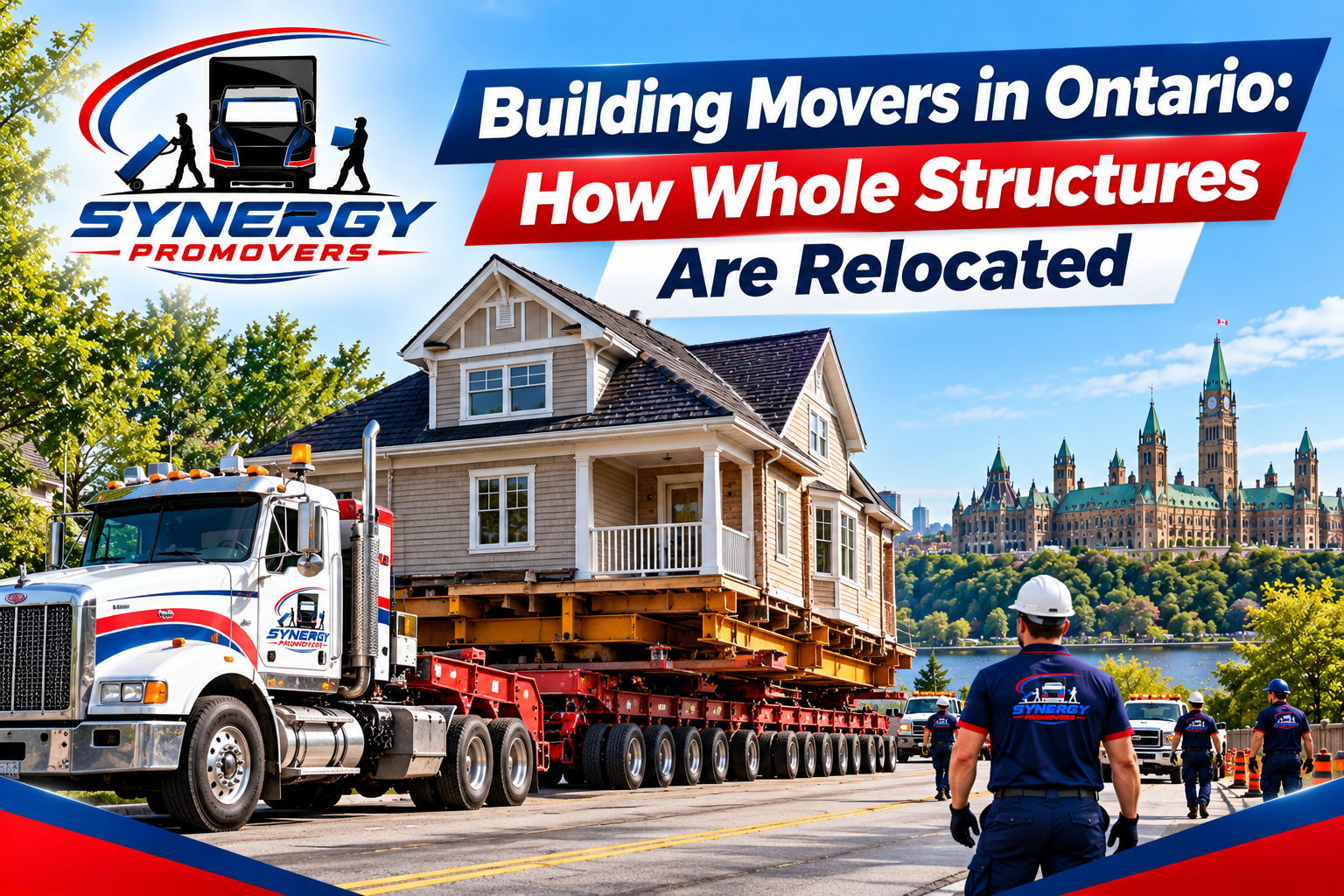
Building movers in Ontario move the structure itself—not the furniture or boxes inside it. A structural mover separates a house, cottage, barn or other building from its existing foundation, supports it for lifting and transport, and sets it down at a new location or position. That is different from a residential moving company, which transports household contents.
Before booking, resolve three questions: can the building be moved, can the receiving site legally accept it, and what approvals do the municipalities and road authorities along the route require? Ontario does not have one checklist for every project. Building permits are generally administered by local municipal departments, while an oversize/overweight permit from the Ministry of Transportation of Ontario (MTO) applies to provincial King’s Highways; municipal roads can require separate permission. Ontario’s building-permit guide and the MTO permit guidance explain those separate roles.
In this guide
What structural building movers do—and how that differs from household movers
How to check whether a move is feasible
Ontario permits, road approvals and heritage rules
The main stages of a building relocation
Cost and schedule factors
How to compare structural-mover proposals
Planning separately for household belongings
What structural building movers do
A structural mover relocates the building shell. Depending on the project, the structure may be raised and shifted on the same property, transported along a road, or moved to a different lot. Hydraulic lifting systems, steel beams and specialised transport equipment support the structure during the work. The exact method depends on the building, site and route.
The phrase “house movers” can mean two different things. Use this distinction when requesting estimates:
| Type of service | What moves | Scope to confirm |
| Structural or building mover | The building itself, lifted off or separated from its foundation | Assessment, lifting and support plan, transport, setting down, permits and any foundation work included in the quote |
| Household mover | Furniture, appliances, boxes and other belongings | Packing, loading, transport, unloading and storage, if needed |
| Building-raising or foundation contractor | A structure lifted and supported while foundation work is done | Whether the contractor only raises and holds the building, or also relocates it |
Do not assume a company that moves household goods also moves buildings. Likewise, a contractor who raises a house for foundation repairs may not handle a road move. Ask each bidder to state exactly which work it will perform and which work belongs to other contractors.
Check feasibility before choosing a mover
A first conversation should establish whether the structure can be moved and whether the destination and route are workable. A structural mover and, where appropriate, a qualified structural engineer can assess the building and outline the information needed for a project plan.
Key factors include:
Building condition and construction: dimensions, approximate weight, framing or masonry, foundation type, additions and the building’s condition all affect how it can be supported.
The receiving property: confirm the proposed location, access, setbacks, zoning and foundation requirements with the municipality before committing to a move date. A site that looks suitable from the road may not meet local planning or building requirements.
The route: measure the complete load on its transport equipment. Check road width, turning space, bridges, overhead utilities, trees, grades, construction and posted restrictions. A short route is not automatically an easy route.
The project objective: compare relocation with alternatives such as rebuilding, raising the building or dismantling and reconstructing it. Those options have different scopes and costs.
For a heritage property, preserving the building does not always mean moving it. Ontario’s conservation guidance says the site is integral to a building’s cultural heritage value and advises against moving a building unless there is no other means to save it. That is a conservation principle, not a general permit rule, but it is an important early consideration for a designated property. Ontario’s eight guiding principles for built-heritage conservation explain the reasoning.
Permits and approvals in Ontario
Contact the building or planning department for both the original property and the receiving property before fixing a move date. Ontario’s guide says building-permit applications are submitted to the municipality, not the provincial government; it also lists excavation or construction of a foundation among work requiring a permit. The local department can explain the drawings, supporting documents, inspections and other approvals required for the specific site.
Ottawa is a useful local example—not a province-wide rule
The City of Ottawa says a building permit is required to relocate or demolish an existing building or structure. The City reviews the application against applicable requirements, including heritage, zoning and, in some areas, demolition control, and it requires utility clearance confirming that services have been disconnected or capped. Its published first-review estimate is 10 business days; that is an initial review estimate, not a promise that all approvals or the project will be completed in that time. See the City of Ottawa’s demolition and relocation permit guidance.
Other Ontario municipalities set their own application details and review processes. Ask each authority what applies at the origin and destination rather than assuming Ottawa’s rules—or another town’s checklist—apply across the province.
Check the transport route with every road authority
MTO permits cover Ontario’s provincial King’s Highways. The province says additional permission may be required directly from a municipality for municipal roads. A route can use both kinds of road, so identify each road authority before the carrier finalises its route plan.
MTO’s guide lists general vehicle-and-load limits of 2.6 metres in width and 4.15 metres in height under standard rules, with exceptions and permit conditions that depend on the vehicle and load. A carrier should measure the building on the transporter and check the applicable permit and route conditions; do not rely on the building’s dimensions alone. MTO’s current service note states a five-business-day turnaround for a single-trip permit. That is only one part of the schedule: municipal permissions, route clearances and other project approvals are separate. Check the permit page and the MTO guide to oversize/overweight vehicles and loads again when planning, because requirements and processing times can change.
Heritage, utilities and site-specific approvals
If a building is individually designated under Part IV of the Ontario Heritage Act, removal is a separate council-consent matter. Ontario’s heritage guidance says the owner must obtain written consent from council to remove a building or structure on the designated property. The described process includes a 90-day decision period after notice of a complete application and a 30-day window to appeal a decision to the Ontario Land Tribunal. If the building is moved to another property, council also determines whether the receiving property meets the criteria for cultural heritage value. A heritage conservation district has its own approval route, so confirm the building’s exact designation and local process with municipal heritage staff. See Ontario’s demolition-control guidance for designated properties.
Utilities and site servicing need their own plan. Confirm who arranges disconnection, capping, clearance and reconnection for each service, and whether overhead lines along the route need work. If the destination relies on a well or septic system, ask the municipality or relevant local authority what approvals and inspections apply there. In Ottawa, the City’s relocation guidance specifically calls for utility clearance.
| Approval area | Who to contact first | What to confirm |
| Original property | Local building and planning departments | Removal or relocation requirements, zoning, heritage status, inspections and road-allowance use |
| Receiving property | Local building and planning departments | Foundation permit, permitted location, zoning, access and site servicing |
| Provincial highway route | MTO and the structural mover | Whether an oversize/overweight permit is needed, the approved route and permit conditions |
| Municipal roads | Each municipality on the route | Whether separate road-use, traffic or other permissions apply |
| Utilities and services | Each affected utility and local authority | Disconnection, clearance, overhead-line coordination and reconnection |
How a whole-structure move works
A building move is planned around the structure, the route and the receiving foundation. The sequence varies, but these are the main stages:
Assess the building. The mover evaluates construction, condition, dimensions, foundation and access. The project team determines whether engineering plans or other professional input are needed.
Survey the route and define the scope. The carrier checks the measured load against the route, identifies clearance or access issues, and confirms which roads and authorities are involved. The written scope should identify who arranges each permit and utility clearance.
Prepare both sites. Approvals are obtained; the receiving site and foundation are prepared; and the origin site is made ready for the lift. Foundation, excavation, drainage and utility work should be assigned clearly rather than assumed to be part of the mover’s price.
Prepare the structure. Utilities are disconnected as required. The mover identifies which contents, attachments or exterior features must be removed or protected before lifting.
Lift and support the building. The specialist places the support system, raises the structure and transfers it onto transport equipment according to the project plan.
Transport, set down and reconnect. The building is moved under the approved route and conditions, placed on the prepared foundation or support, checked and reconnected as required by the project approvals.
Not every quote covers all six stages. Some contractors handle the lift and transport only; others may coordinate additional site work or foundation services. Confirm the handoffs before work begins.
What affects the cost and schedule?
There is no useful one-price figure for every building move. A quote depends on the specific building, sites and route, and it can omit major work if the scope is not itemised.
| Cost or schedule factor | Why it matters |
| Building size, weight, construction and condition | Affects support design, lifting plan and transport equipment |
| Distance and route complexity | Clearances, turns, bridges, road restrictions and utility coordination can change the plan |
| Engineering, surveys and permits | Requirements vary with the structure, municipality, route and project scope |
| Work at both properties | Excavation, foundation construction, access and site restoration may be separate contracts |
| Utility and service work | Disconnection, line coordination and reconnection can involve other providers |
| Contents and temporary accommodation | Household belongings and occupants need a separate plan if the building cannot be used during the work |
Ask for an itemised written proposal that separates the structural mover’s work from engineering, permits, foundation construction, utilities, escorts or traffic measures, site restoration and household moving or storage. Have the quote state exclusions, assumptions, schedule milestones, payment terms, change-order process and who is responsible for damage while the structure is lifted or in transit. A price from a different building or route is not a reliable estimate for yours.
For scheduling, do not confuse the travel day with the full project. Municipal review, heritage approval, route planning, utility work and foundation preparation all happen around the move itself. Start discussions before committing to a date, and ask each authority and contractor for its current requirements and schedule.
How to compare structural-mover proposals
A low quote is not useful if it leaves out the work that makes the move possible. Ask every candidate the same questions and compare the written answers:
Relevant experience: Can the company show completed projects involving a similar building type, construction, size and route? Ask for references you can contact.
Engineering and responsibility: Who prepares or reviews the support and lifting plan? Which professionals are retained, and who coordinates with the municipality?
Equipment and subcontractors: What equipment is proposed for this building, and will any part of the job be subcontracted? Ask for the subcontractor’s role and documentation.
Insurance and risk: Request current insurance documents and confirm the coverage, limits, exclusions and responsibility during lifting, transport and set-down. Ask how subcontractors are covered.
Permits and route: Identify who applies for each municipal and MTO approval, who pays the fees and what happens if the approved route or timing changes.
Written scope: Get the sequence, included services, exclusions, price basis, schedule, change process and damage procedure in writing before signing.
The International Association of Structural Movers’ directory can be one way to find specialist companies. The association also publishes a structural-mover hiring checklist. Treat a directory as a source of candidates, not a substitute for checking project-specific experience, references, insurance and scope.
Plan separately for household belongings
A structural move and a household move are two different jobs with different schedules. Do not assume furniture, appliances or boxes can remain inside while a building is lifted or transported; confirm that point in writing with the structural mover and plan to remove contents unless the project team approves otherwise.
If belongings need to be packed, moved or stored while the building work is under way, arrange that as a separate service. Synergy Pro Movers offers packing and household moving support and moving and storage services. The contractor responsible for the structure should remain clearly identified in the project plan.
Common questions about moving a building
Can a house be moved a few metres on the same property?
It can be physically possible, but do not assume a short or same-lot move is exempt from approvals. Ottawa, for example, requires a building permit to relocate an existing building or structure. Ask the municipality responsible for the property before starting work.
Does an MTO permit cover every road on the route?
No. MTO oversize/overweight permits apply to provincial King’s Highways. Municipal roads can require separate permission from the municipality, so have the carrier list every road authority on the proposed route.
Does a structural mover always build the new foundation?
No. Foundation construction may be handled by a separate contractor. Make sure the proposal states who designs, permits, builds and inspects the receiving foundation, and how the structure will be set onto it.
What information should I gather before asking for an assessment?
Provide the origin and destination addresses, photographs of the building and foundation, approximate dimensions, construction type, known condition, any additions, access details and your preferred timing. If available, include plans, surveys and information about heritage designation or site servicing. The mover can then identify what else is needed for a proper assessment.