
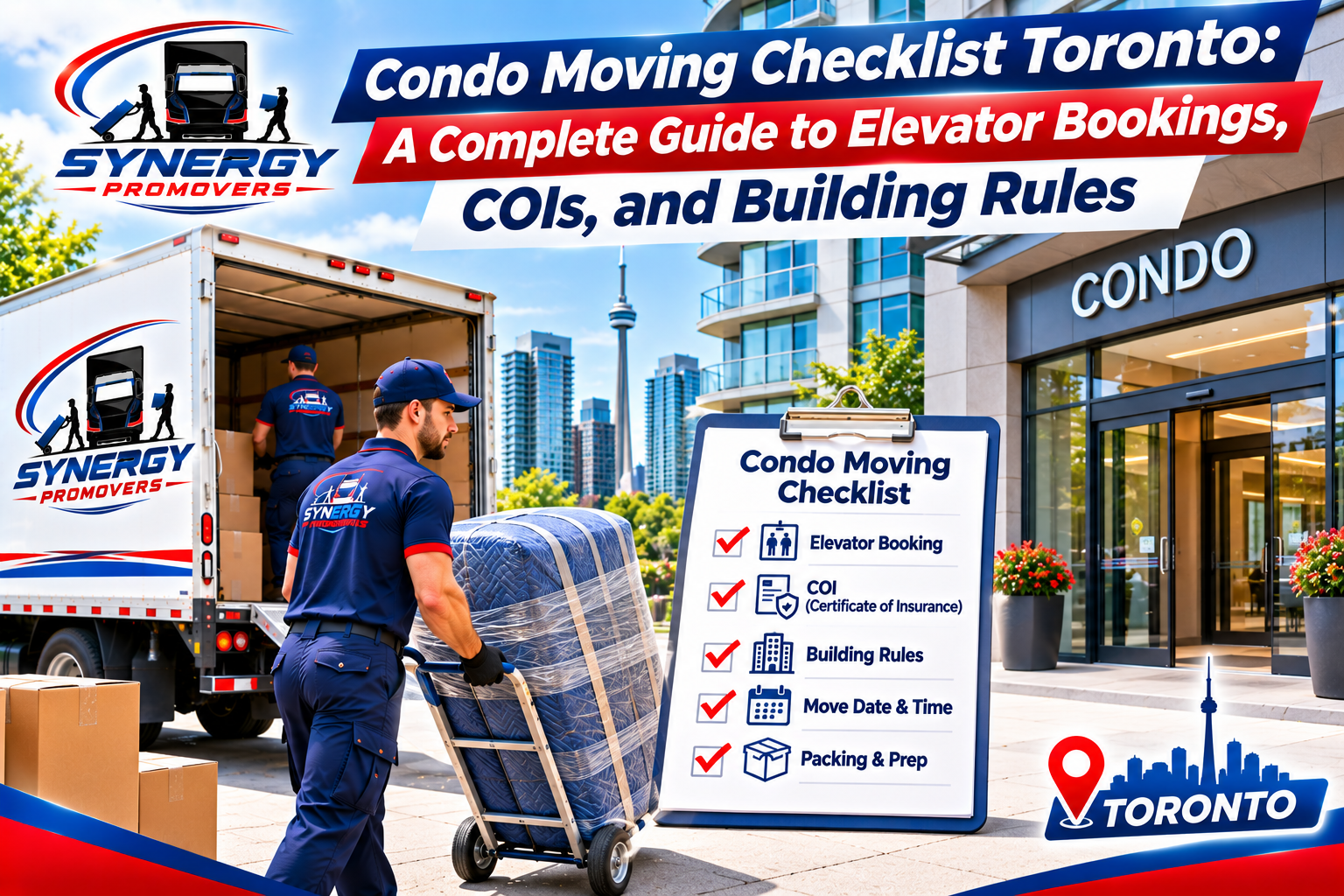
Moving into or out of a high-rise involves a layer of logistics that house moves simply do not have. Before a single box crosses the threshold, you will need to coordinate with your property management office, secure a service elevator reservation, provide proof of insurance, and confirm that the moving truck can physically fit into the building’s loading bay. This guide walks through every building-compliance and logistical step so your move proceeds smoothly and without surprise fees.
Key Takeaways
- Most Toronto and Ottawa condo corporations require a Certificate of Insurance (COI) naming the condominium corporation as an additional insured before any move takes place.
- Service elevator bookings typically open two to four weeks in advance and may be limited to specific time windows, often with a strict two-and-a-half to three-hour cap.
- Underground loading bay vertical clearance varies significantly between buildings and determines which truck sizes can access the dock.
- Condo moving elevator security deposit and fees structures differ by building; confirming the exact amount and refund conditions in writing prevents disputes on moving day.
- Staging boxes near the unit door and using a long-carry strategy from the freight elevator to the suite can dramatically reduce the time spent inside the reserved elevator window.
Booking the Service Elevator: Timing, Deposits, and Overage Rules
The single most time-sensitive task on your condo moving checklist toronto residents face is securing the service elevator. Most condominium corporations in the Greater Toronto Area — from Liberty Village and CityPlace towers to King West and Harbourfront high-rises — require you to book the freight elevator through the property management office or concierge desk well before your moving date.
How far in advance to book moving elevator in a condo depends on the building and the season. During peak moving months (May through September), popular buildings in Downtown Toronto and North York may require reservations three to four weeks ahead. In quieter periods, two weeks may be sufficient. The safest approach is to contact your property management office as soon as you have a confirmed moving date and ask for their specific booking window.
When you book, you will typically encounter a condo moving elevator security deposit and fees structure that varies by building. Many Toronto Standard Condominium Corporation (TSCC) buildings collect a refundable damage deposit — commonly in the range of several hundred dollars — along with a non-refundable administrative fee. The deposit is returned after the move if the elevator, hallways, and common areas are undamaged. To protect your deposit, ensure the crew uses protective elevator wall pads and floor runners throughout the move, and confirm the refund timeline and conditions in writing before moving day.
What happens if movers go over the 3 hour elevator window is another critical question. Most buildings enforce the elevator reservation strictly because other residents have bookings immediately after yours. If the crew exceeds the reserved window, the building may charge an overage fee per additional half-hour, or the concierge may require the crew to pause and yield the elevator to the next reservation. This is why efficient staging and a well-coordinated crew are essential — a delay of even thirty minutes can cascade into additional charges and scheduling conflicts.
Certificate of Insurance (COI) Requirements
What is a Certificate of Insurance (COI) for a condo move and how do I get one? A COI is a document issued by the moving company’s insurance provider that confirms the mover carries active Commercial General Liability coverage and names your specific condominium corporation as an additional insured party for the date of the move. Most TSCC and Ottawa-Carleton Standard Condominium Corporation (OCSCC) buildings require a COI before they will release the service elevator lock-off key.
The coverage amounts buildings request vary, but a common requirement falls in the range of $2,000,000 to $5,000,000 in Commercial General Liability. Your moving company should be able to provide a COI that meets your building’s specific threshold. Request the COI at least one to two weeks before your move, because the insurance provider may need several business days to process the additional-insured endorsement. Deliver the COI to your property management office according to their preferred method — some accept email, while others require a hard copy dropped off at the concierge desk.
If your mover cannot provide a COI that meets the building’s requirements, the property management office may refuse to authorize the elevator booking. Confirm the exact coverage amount and naming convention your building requires before you finalize your mover selection.
Loading Dock Logistics and Truck Clearance
Downtown condo loading dock height clearance for moving trucks is one of the most frequently overlooked details in high-rise relocations. Underground loading bays in Toronto condos — particularly in older buildings along the Harbourfront and in CityPlace — often have vertical clearance restrictions that prevent standard large moving trucks from entering. Clearance heights can vary significantly between buildings, and a truck that is even a few inches too tall will be forced to park on the street, which introduces additional long-carry distance and may require a city parking permit.
What size moving truck fits into an underground condo loading bay depends entirely on the building’s specific vertical clearance. Before your move, ask the property management office for the exact clearance measurement in feet and inches, and share that number with your moving company so they can assign an appropriately sized vehicle. Smaller cube vans or low-profile trucks are often necessary for underground bays with limited headroom.
Moving into a condo without a loading dock parking permit is another scenario that requires advance planning. If the building has no dedicated loading dock — or if the dock is occupied — the truck will need to park on the street. In Downtown Toronto, this typically requires a temporary parking permit from the City of Toronto for the moving vehicle. Apply for the permit through the city’s parking authority well in advance, and confirm the specific street restrictions for your building’s address. Buildings in dense areas like King West or Yonge and Eglinton often have limited street parking, making the permit essential to avoid ticketing or towing on moving day.
Measuring Elevator Dimensions and Staging Strategy
Measuring freight elevator dimensions for sectional couch clearance and other oversized furniture is a step that can save you significant time and frustration. Before moving day, measure the interior width, depth, and door opening height of the building’s service elevator, and compare those dimensions against the largest items in your inventory. A sectional sofa that fits comfortably in a house-move scenario may need to be disassembled to navigate a compact freight elevator in a Downtown Toronto high-rise.
How to stage boxes for a fast condo move is equally important for staying within your elevator window. The most effective approach is a long-walk staging strategy: pre-position all boxes and smaller items near your suite door before the elevator reservation begins, so the crew can load them in rapid succession rather than making repeated trips down the hallway. Using 4-wheel commercial moving dollies and commercial bin carts allows the crew to move multiple boxes per trip, which is critical when the clock is ticking on a two-and-a-half or three-hour booking.
How do professional movers finish a condo move within a strict 2.5 or 3-hour elevator booking? The answer combines preparation with crew efficiency. A well-staged move with boxes pre-positioned, furniture disassembled in advance, and a clear path from the elevator to the unit can be completed within the window even for a fully furnished one-bedroom condo. The key is minimizing the number of trips the crew makes through the hallway and maximizing the load per elevator cycle.
Weekend, Holiday, and Building-Specific Restrictions
Can you move into a Toronto or Ottawa condo on weekends or statutory holidays? The answer depends entirely on your building’s rules. Many TSCC buildings in Downtown Toronto restrict moves to weekday business hours — typically Monday through Friday between 9:00 a.m. and 5:00 p.m. — to minimize disruption to residents. Weekend moves may be permitted in some buildings but often require special approval from the property management office and may carry additional fees.
Statutory holiday moves are generally prohibited in most condominium corporations. If your move date falls near a long weekend, plan for the possibility that the building will not authorize an elevator booking on the holiday itself, which may require shifting your schedule by a day or two.
Buildings in Downtown Ottawa condos — including towers in Centretown, ByWard Market, Little Italy, and the Lansdowne / The Glebe area — follow similar patterns, though some smaller buildings may offer more flexibility. If your move involves a property in Downtown Montreal condos in areas like Griffintown or Old Montreal, be aware that Quebec’s July 1st moving day (Jour du déménagement) creates extreme demand and may affect elevator availability even in buildings that normally permit weekend moves.
Crew Size and Cost Considerations
Is it better to hire 2 or 3 movers for a high-rise condo move? For most one-bedroom and studio condos, a two-person crew is sufficient and more cost-effective. The confined space of a freight elevator and narrow condo hallways means a third mover may not add meaningful speed and can actually slow the process by creating congestion. However, for larger condos with heavy furniture, a three-person crew can reduce total hours enough to offset the higher per-hour rate.
The cost to move a 1 bedroom condo in toronto and ottawa depends on crew size, building access conditions, travel distance, and the time of year. High-rise moves in dense urban cores like Downtown Toronto or Mississauga Square One often involve additional time for parking, long carries, and elevator coordination, which can increase the total compared to a ground-level apartment move of the same size. Request a detailed quote that accounts for building-specific factors, and confirm whether the estimate includes elevator overage contingencies.
Your Pre-Move Timeline
To keep every element of your move on track, follow this general timeline:
- Four to six weeks out: Confirm your moving date, contact the property management office to learn the building’s specific move-in/move-out rules, and request the COI requirements and elevator booking window.
- Three to four weeks out: Book the service elevator, submit the COI, pay any required deposits, and apply for a city parking permit if street parking will be needed.
- Two weeks out: Measure the freight elevator and loading bay clearance, confirm truck size with your mover, and begin staging boxes near your unit door.
- One week out: Confirm all bookings with the property management office and your moving company, verify the elevator reservation time, and finalize your staging plan.
- Moving day: Arrive early, confirm the elevator lock-off key is available at the concierge desk, and ensure protective pads and runners are in place before the first load.
Planning Your Condo Move with Confidence
A successful high-rise relocation comes down to preparation and communication. By understanding your building’s specific rules, securing the right documentation, and coordinating closely with your moving team, you can avoid the delays and surprise charges that catch many first-time condo movers off guard.
When you are ready to book, working with experienced Toronto condo movers who understand the logistics of high-rise buildings can make a significant difference. Whether you need condo and apartment moving services for a Liberty Village studio or downtown Ottawa movers for a Centretown high-rise, choosing a team familiar with elevator bookings, COI requirements, and loading dock constraints helps ensure your move stays on schedule and within budget. If you would like to reduce moving-day stress further, consider full-service condo packing so your boxes are staged and ready before the elevator clock starts.
Published by Synergy Pro Movers. Last updated: July 2025. This guide provides general information based on common condominium building practices in Ontario and should not be taken as legal or insurance advice. Confirm all requirements with your specific property management office.
Frequently Asked Questions
What is a Certificate of Insurance (COI) for a condo move and how do I get one?
A COI is a document from your moving company’s insurance provider confirming active Commercial General Liability coverage and naming your condominium corporation as an additional insured. Request it from your mover at least one to two weeks before your move and deliver it to the property management office. Most buildings will not release the service elevator without a valid COI on file.
How do professional movers finish a condo move within a strict 2.5 or 3-hour elevator booking?
Efficiency comes from preparation: boxes pre-staged near the unit door, furniture disassembled in advance, protective pads already in place, and a clear path from the freight elevator to the suite. Using commercial dollies and bin carts maximizes the load per elevator trip, and a well-coordinated two-person crew can typically complete a one-bedroom condo move within the standard window.
What size moving truck fits into an underground condo loading bay?
The answer depends on your building’s specific vertical clearance, which can vary significantly between older and newer constructions. Ask the property management office for the exact clearance measurement in feet and inches, then share it with your moving company so they can assign a truck that fits. Low-profile cube vans are often required for underground bays with limited headroom.
Can you move into a Toronto or Ottawa condo on weekends or statutory holidays?
Most condominium corporations restrict moves to weekday business hours to minimize resident disruption. Weekend moves may be available with special approval and additional fees, but statutory holiday moves are generally prohibited. Confirm your building’s specific policy with the property management office before scheduling your move date.
How do I prevent losing my $500 condo elevator damage deposit?
The most effective approach is to ensure the moving crew uses protective elevator wall pads, floor runners, and banister protection throughout the move. Document the condition of the elevator and common areas with photos before and after the move, and confirm the deposit refund conditions and timeline in writing with the property management office before moving day.
Is it better to hire 2 or 3 movers for a high-rise condo move?
For most one-bedroom and studio condos, a two-person crew is more efficient because freight elevators and condo hallways are confined spaces where a third mover can create congestion. A three-person crew may be worthwhile for larger units with heavy furniture, where the additional speed can offset the higher hourly rate by reducing total hours on the clock.
How far in advance should I book the moving elevator in my condo?
During peak moving season (May through September), book the service elevator three to four weeks in advance, especially for popular buildings in Downtown Toronto, North York, or Mississauga Square One. In off-peak months, two weeks may be sufficient. Contact your property management office as soon as you have a confirmed moving date to secure your preferred time slot.