

Choosing a reliable long-distance moving company in Ottawa starts with verifying the provider, comparing written estimates on the same basis, confirming pickup and delivery arrangements, and understanding who is responsible for your belongings. The goal is to choose a company whose identity and relevant claims you can check, whose services match your needs, and whose terms are clear before you book.
A low quote does not necessarily represent the best value, just as positive reviews do not guarantee a successful move. Estimates can differ because of inventory assumptions, included services, access conditions, scheduling, and contractual terms. Comparing these details helps you make a more informed decision than relying on price or advertising alone.
Use the following steps to evaluate long-distance moving companies in Ottawa, identify unanswered questions, and decide when you have enough information to book confidently.
What Makes a Long-Distance Moving Company in Ottawa Reliable?
A reliable long-distance moving company should provide identifiable business information, explain how the move will be handled, give clear written terms, and answer reasonable questions about costs, services, scheduling, and responsibility for belongings. No single review, credential, or company statement can guarantee performance.
Verify the Company’s Identity and Reputation
Start by confirming which business you are considering. Check its published name and contact information, look for independent information about its reputation, and investigate inconsistencies before committing.
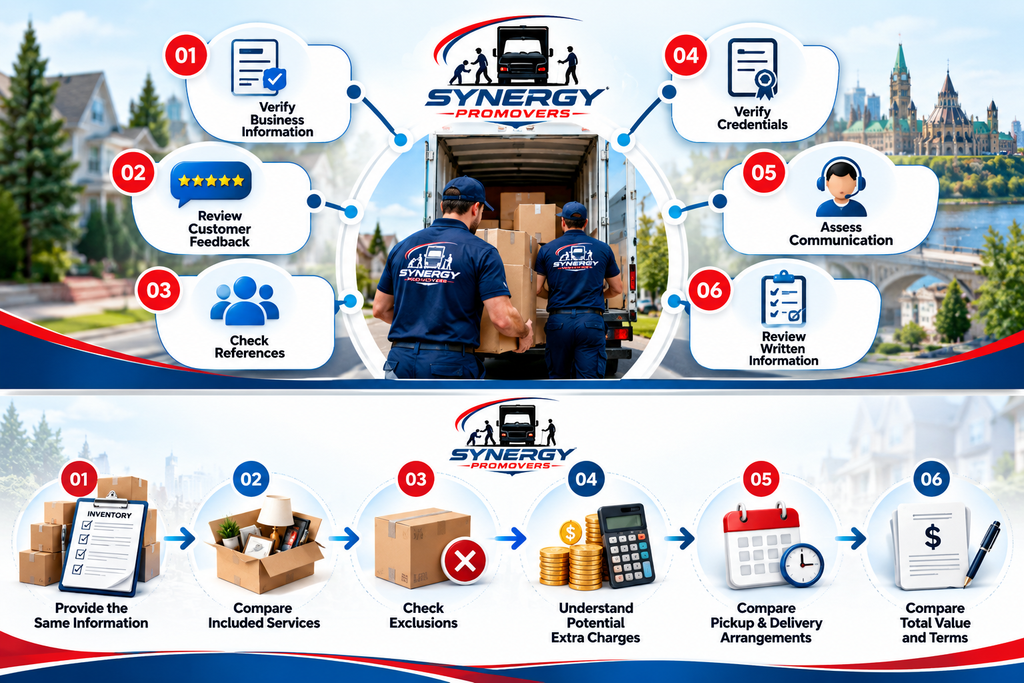
Use this checklist to guide your research:
- Verify the business information. Confirm the company’s identity and contact details. Ask for clarification if names or other important information differ across its website, estimate, and agreement.
- Review customer feedback. Look for patterns in comments about communication, pricing, scheduling, and how problems were handled. Consider several sources rather than relying on one unusually positive or negative review.
- Check references where appropriate. Ask whether the company can provide relevant references or other verifiable information about its work.
- Verify claimed credentials. If a company claims membership in an industry association or holds a particular credential, check the claim directly with the organization responsible for it.
- Assess communication. Notice whether the company answers specific questions clearly and explains its terms rather than relying on broad promotional promises.
- Review its written information. Make sure the estimate and agreement identify the services and responsibilities that matter to your move.
Before hiring a long-distance moving company in Ottawa, research the company, check customer reviews and references, and compare written estimates. Verify the mover’s credentials, insurance coverage, and professional affiliations before making a decision. These steps can help you choose a reliable moving company and prepare for a smoother relocation.
Treat reviews as indicators, not proof. Several detailed reviews describing similar experiences may provide useful context, but reviews alone cannot establish how a company will handle your specific move.
Similarly, an association membership or credential should be verified rather than accepted at face value. Membership can help with your assessment, but it is not an automatic guarantee of service quality.
Confirm Who Will Actually Handle the Move
The business you contact may not be the only company involved in transporting your belongings. Some providers perform the move themselves, while others arrange transportation through subcontractors or operate as moving brokers.
A moving broker arranges transportation through other providers. The actual division of responsibilities depends on the arrangement and agreement. The Government of Canada warns that subcontracting can create confusion about responsibility when a dispute arises, so consumers should establish who is responsible for the services from beginning to end.
Before booking, ask:
- Which business will enter into the agreement with me?
- Who will physically collect and transport my belongings?
- Will a broker, subcontractor, or another moving company be involved?
- Who will coordinate pickup and delivery?
- Who is responsible for answering questions, resolving problems, and handling claims?
Using a broker or subcontractor is not automatically improper. What matters is whether the arrangement is explained clearly and whether you understand each party’s role.
If several businesses are involved, ask for the relevant names and responsibilities in writing. If the company cannot explain who is contracting with you or who is responsible for key services, investigate further before committing.
How to Compare Long-Distance Moving Company in Ottawa Quotes Fairly
Compare long-distance moving quotes by giving each company the same information about your move and checking the written terms alongside the total price. The most useful comparison covers inventory assumptions, included services, exclusions, potential additional charges, payment terms, and delivery arrangements.
Why Moving Quotes Can Differ
When comparing quotes from a long-distance moving company in Ottawa, remember that two estimates may differ because they may not cover the same requirements. The size and contents of your shipment, access conditions, travel distance, moving date, requested services, and special-handling needs can all affect the proposed arrangements and overall cost.
For example, one company may include packing assistance while another assumes you will pack your belongings yourself. One estimate may account for difficult access at your property, while another may be based on incomplete information.
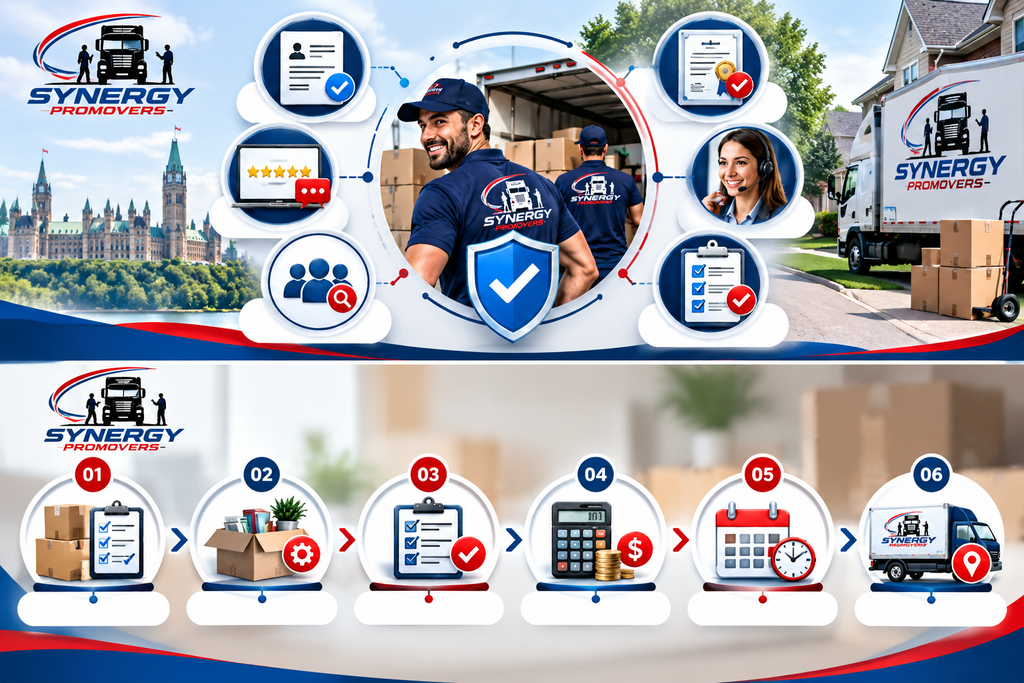
Prepare the same basic information for every company you contact:
- Pickup location and destination.
- Preferred moving dates and scheduling constraints.
- A reasonably complete inventory of the belongings to be moved.
- Relevant access details, including stairs, elevators, parking restrictions, or other difficulties.
- Packing, storage, or specialty-handling services you require.
- Items that may need special care or additional arrangements.
Check that each company has considered the same relevant inventory and access conditions. Tell providers about important items or requirements that could affect the estimate, and ask how changes to the inventory or services may affect the price.
The Government of Canada recommends preparing an inventory and ensuring that the mover has the information needed to produce an estimate. It also advises consumers to obtain estimates from multiple reputable movers.
Getting several estimates helps you compare providers, but the number of quotes alone does not establish which company is the right choice.
What to Compare Beyond the Total Price
Once you have written estimates, compare them item by item. Similar totals do not necessarily mean that two companies are offering the same services or making the same commitments.
| Comparison item | What to check | Question to ask |
| Inventory and assumptions | Items, shipment details, access conditions, and other information used for the estimate | Is this estimate based on the complete information I provided? |
| Services included | Packing, loading, unloading, storage, or other services you requested | Which services are included in the quoted price? |
| Exclusions | Services or circumstances not covered by the estimate | What will I need to arrange or pay for separately? |
| Additional charges | Circumstances that could change the price or require extra services | What situations could result in additional charges? |
| Pickup and delivery | Proposed dates, delivery expectations, and scheduling conditions | Which dates are confirmed, and which are estimates? |
| Payment terms | Payment schedule and applicable conditions | When is payment due, and what terms apply? |
| Written agreement | Documented services, prices, and responsibilities | Where can I review the complete terms before booking? |
Use this table as a practical comparison tool, not as a substitute for reading the actual estimate and agreement.
A lower quote may represent good value if it covers the services you need and its terms are clear. It may be less attractive if important services are excluded or key assumptions remain unresolved. A higher quote is not automatically better either; the company should be able to explain what the additional cost covers.
If you want more background on moving services and cost considerations, read Packing and Moving Companies: Costs, Services & Expert Moving Tips for 2026. Use that article for broader context, while relying on your own written estimates to compare specific providers.
Important: Estimate and contract rules can depend on the applicable jurisdiction and the type of agreement. Ontario’s explains consumer protections and contract requirements relevant to moves covered by Ontario law. Do not assume that every Ontario-specific rule applies identically to every long-distance move, especially when another jurisdiction is involved.
What Should You Confirm About Services, Pickup, and Delivery?
Before booking a long-distance moving company in Ottawa, confirm which services the moving company will provide, what you need to arrange yourself, and how pickup and delivery will be coordinated. Make sure all important commitments are recorded in writing so you can compare the agreed terms with the services offered.
Clarify Service Inclusions and Customer Responsibilities
Do not assume that every service associated with moving is included in the quoted price. Packing, loading, unloading, storage, and specialty handling may be offered under different arrangements, depending on the provider and your requirements.
Ask the company to describe the services included in your estimate. If you need a particular service, confirm that the provider offers it and that the estimate accounts for it. If you do not need a service, check that it has not been included unnecessarily.
Clarify your own responsibilities as well. You may need to provide an accurate inventory, identify items requiring special arrangements, disclose access restrictions, or complete certain preparation tasks before pickup. The exact responsibilities depend on the agreement.
For each important task, establish:
- Service: What has the company agreed to do?
- Responsible party: Who will perform or arrange the task?
- Customer requirements: What information or preparation must you provide?
- Written confirmation: Where is the commitment documented?
- Unresolved details: What still needs clarification?
This is especially useful when more than one provider is involved. Rather than assuming that a phrase such as “full-service move” means the same thing everywhere, ask for a clear description of the actual services included.
Confirm Pickup, Delivery, and Communication Arrangements
Pickup and delivery deserve particular attention when belongings are travelling a long distance. A proposed schedule, an estimated delivery window, and a confirmed date are not necessarily interchangeable.
Before booking, clarify:
- The proposed pickup date and any conditions attached to it.
- The expected delivery date or window, and whether it is confirmed or estimated.
- How the company will communicate schedule changes.
- Who will provide updates during the move.
- Whom you should contact if pickup or delivery is delayed.
- What happens if your inventory, access arrangements, or moving requirements change.
- Whether another company will be involved in transportation or coordination.
For example, if you need to arrange access to your new home, establish whether the proposed delivery timing gives you enough flexibility. If the delivery timing is an estimate, ask how updates will be handled rather than treating it as a guarantee.
Record important arrangements in the estimate, agreement, or other written confirmation. If an answer remains unclear, request clarification before relying on it.
How Should You Evaluate Reviews, Protection, and Warning Signs?
Evaluate reviews alongside verifiable business information and written terms. If a company gives inconsistent information, avoids reasonable questions, or will not clarify important commitments, investigate further before booking. You should also establish how the agreement addresses lost or damaged belongings, including relevant protection arrangements and claims procedures.
Warning Signs That Deserve Further Investigation
Certain concerns should prompt additional questions or independent verification. They do not automatically prove fraud or misconduct, but they should not be ignored.
Pay attention to the following:
- Inconsistent business information: Names or contact details do not match across the documents or sources you have checked.
- Unclear estimates: The company cannot explain what the quoted price covers or which assumptions affect it.
- Unexplained charges: Potential additional charges are mentioned without a clear explanation of when they may apply.
- Pressure to commit: You are urged to book before having a reasonable opportunity to review important terms.
- Unclear payment conditions: The company cannot explain its requested payment arrangements or provide the relevant terms.
- Unverified credentials: The company claims an association membership or credential that you cannot confirm with the relevant organization.
- Unclear responsibility: The company cannot explain who will handle the move or whom you should contact if something goes wrong.
- Reluctance to provide written clarification: Material promises or responsibilities remain vague after you ask for them in writing.
The Government of Canada identifies issues such as the absence of a physical address, estimates that are not provided in writing, and large upfront deposits as potential warning signs. These should be assessed in context rather than treated as automatic proof of misconduct.
When investigating a concern, follow three steps:
- Identify the issue. Record the inconsistency, missing information, or unanswered question.
- Ask a specific question. Give the company an opportunity to explain the issue clearly.
- Verify the explanation. Check relevant documents, contact the credential issuer if necessary, and review the written agreement.
For instance, if the business name on an estimate differs from the name on the website, ask which entity will contract with you and why the names differ. Seek supporting information rather than assuming the discrepancy proves wrongdoing.
If a material concern remains unresolved, consider delaying the booking while you investigate or evaluating another provider. An unanswered question should not be treated as a confirmed commitment.
Clarify Responsibility for Lost or Damaged Belongings
Before booking, ask how the moving agreement addresses belongings that are lost or damaged. Find out what protection arrangements are available, which terms and exclusions apply, how concerns must be reported, and which claims procedures or deadlines are relevant to your move.
Do not assume that a company having business insurance automatically means your belongings are covered in the same way. Business insurance, contractual liability, and protection arrangements for a customer’s shipment are related but distinct matters.
Ask the provider:
- What does the agreement say about responsibility for lost or damaged belongings?
- What protection options are available for my shipment?
- What do those options cover, and are there exclusions or limits?
- How should loss or damage be documented and reported?
- Which claims procedure applies, and are there deadlines I need to follow?
- Where can I review these terms before signing?
Read the relevant documents instead of relying solely on a verbal explanation. Keep copies of the estimate, agreement, inventory, and written communications relevant to your move.
The rules that apply may depend on the route, agreement, jurisdiction, and protection arrangement. Ontario consumer guidance can help you understand requirements relevant to moves covered by Ontario law, but it should not be treated as a universal statement of the rules for every long-distance move.
The moving advice is a useful starting point for questions about insurance and protecting belongings. For a specific contractual or insurance concern, review the actual terms and consult the relevant official guidance or a qualified professional.
How Do You Balance Affordability, Reliability, and Service Fit?
Choose the long-distance moving company in Ottawa whose documented information, service scope, written terms, and moving arrangements best fit your needs and budget—not automatically the provider offering the lowest quote.
Price matters, but it is meaningful only when you understand what you are paying for. An estimate that excludes a service you need is not directly comparable to one that includes it. Likewise, clear written terms make a provider easier to evaluate, but they cannot guarantee that the move will go smoothly.
Use this framework to compare your options:
| Decision factor | What to record | What may need further investigation |
| Company verification | Information you have independently checked | Inconsistent details or unverified credentials |
| Price transparency | Quoted total, scope, assumptions, and exclusions | Unexplained charges or missing information |
| Service fit | Services included and responsibilities assigned | Important tasks missing from the estimate |
| Pickup and delivery | Proposed schedule and communication arrangements | Unclear dates or unresolved coordination |
| Written terms | Commitments documented in the agreement | Important promises that remain verbal |
| Protection and claims | Relevant terms and procedures reviewed | Unclear responsibility, exclusions, or deadlines |
For each factor, distinguish between what the company claims, what you have independently verified, what is confirmed in writing, and what remains unresolved. That distinction is more useful than assigning arbitrary scores to providers.
Then ask yourself three questions:
- Does the estimate reflect my actual move? Check the inventory, access conditions, timing, and services required.
- Can I verify the important information? Separate independent evidence from company statements and promises.
- Are the remaining uncertainties acceptable? Resolve material questions about price, responsibilities, delivery, and protection before committing.
A lower-priced company may be suitable when its scope and terms meet your needs. A higher-priced company may be worth considering if its estimate includes services you require, but the additional cost should be explained rather than assumed to represent better quality.
No comparison framework can eliminate every risk. Its purpose is to make differences between providers visible and help you make a decision based on evidence, service fit, and clear commitments.
What Questions Should You Ask Before Booking a Long-Distance Moving Company in Ottawa?
Before booking, ask questions that establish who is responsible for the move, what the estimate covers, how pickup and delivery will work, and what happens if the schedule, costs, or condition of your belongings becomes an issue.
Use this checklist during conversations with prospective movers.
Company identity and responsibility
- Which business will enter into the agreement with me?
- Who will physically handle the move?
- Will a broker, subcontractor, or another provider be involved?
- Who will coordinate the service and respond to problems?
Estimate and services
- Is the estimate based on my inventory, addresses, access conditions, and moving dates?
- Which services are included, and which must I arrange separately?
- What circumstances could result in additional charges?
- How would changes to the inventory or requirements affect the estimate?
Pickup, delivery, and communication
- What pickup date and delivery window are proposed?
- Which dates are confirmed, and which are estimates?
- How will I receive updates if the schedule changes?
- Whom should I contact if there is a delay?
Payment, written terms, and protection
- What payment terms apply, and when is payment due?
- Where can I review the complete agreement before committing?
- What does the agreement say about lost or damaged belongings?
- What protection options, exclusions, and claims procedures apply?
- Are there any unresolved conditions I should understand before booking?
If a commitment matters to your decision, ask for written clarification and keep the relevant documents. Review the answers alongside the agreement rather than accepting a reassuring verbal response as proof that every detail is settled.
How to Make Your Final Decision
Choosing a reliable long-distance moving company in Ottawa is a process of verification, comparison, and clarification. Before booking, make sure you can explain why the provider fits your requirements using documented information rather than price or promotional claims alone.
Work through these final steps:
- Verify the provider. Confirm its identity, check relevant credentials, and establish who will handle and coordinate the move.
- Compare written estimates. Make sure each estimate reflects comparable inventory, services, assumptions, and requirements.
- Confirm the arrangements. Understand the included services, your responsibilities, and the proposed pickup and delivery process.
- Review the terms. Check payment conditions and the provisions covering lost or damaged belongings.
- Resolve material uncertainties. Ask further questions or seek independent verification when information is inconsistent or incomplete.
- Choose based on fit. Weigh affordability, service requirements, documented commitments, and the quality of the available evidence.
Before committing, check that you can identify the business you are hiring, understand the estimate, review the written terms, and explain how the move will be coordinated. You should also know whom to contact about problems and where to find the relevant protection and claims provisions.
If important questions remain unanswered, pause and seek clarification before booking. If a company will not explain material terms, consider whether another provider would give you a clearer basis for making the decision.
These checks cannot guarantee a trouble-free move, but they can help you identify avoidable uncertainty and compare companies more consistently.
Exploring a Moving Provider
Once you have established your requirements and understand how to evaluate estimates and written commitments, you can review individual providers’ published information and ask how their services fit your move.
The Synergy Pro Movers website is a starting point for reviewing the company’s published information. Before requesting or accepting an estimate, confirm that the company currently offers the services you need, serves your intended route, and can document the arrangements relevant to your move.
Treat any provider’s claims as information to verify, not as a substitute for comparing estimates and reviewing the agreement. The aim is to choose a company whose relevant information can be checked, whose terms are clear, and whose proposed services match your needs.
Frequently Asked Questions
How far in advance should I contact long-distance moving companies?
Contact moving companies as soon as your plans and approximate dates become clear. The lead time you need depends on the route, preferred dates, season, services required, and provider availability. There is no single booking window that applies to every move.
Contacting companies early gives you more time to compare written estimates, verify information, and review the agreement. Confirm availability directly rather than assuming your preferred date is secured.
What Information Should I Provide to a Long-Distance Moving Company in Ottawa to Get an Accurate Quote?
Provide the pickup and destination addresses, intended moving dates, an accurate inventory of your belongings, relevant access conditions, and the services you require. Identify items that may need special handling and explain any scheduling constraints.
If important details are unknown, tell each company rather than allowing providers to make different assumptions. Review the resulting estimates to confirm that each company has considered the same relevant requirements.
What should I do if a moving company will not clarify important terms in writing?
Ask the moving company to explain the specific term and provide written clarification before you commit. Review the estimate and agreement carefully to see whether the issue is already addressed. You can also consult the Government of Canada’s moving advice for helpful guidance on choosing a mover and understanding your responsibilities.
If a material commitment remains unclear, consider delaying the booking or evaluating another provider. You can also review the to learn more about checking a moving company’s credentials and professional affiliations. Reluctance to clarify an important term does not automatically prove misconduct, but you should not treat an unresolved issue as an agreed commitment.