
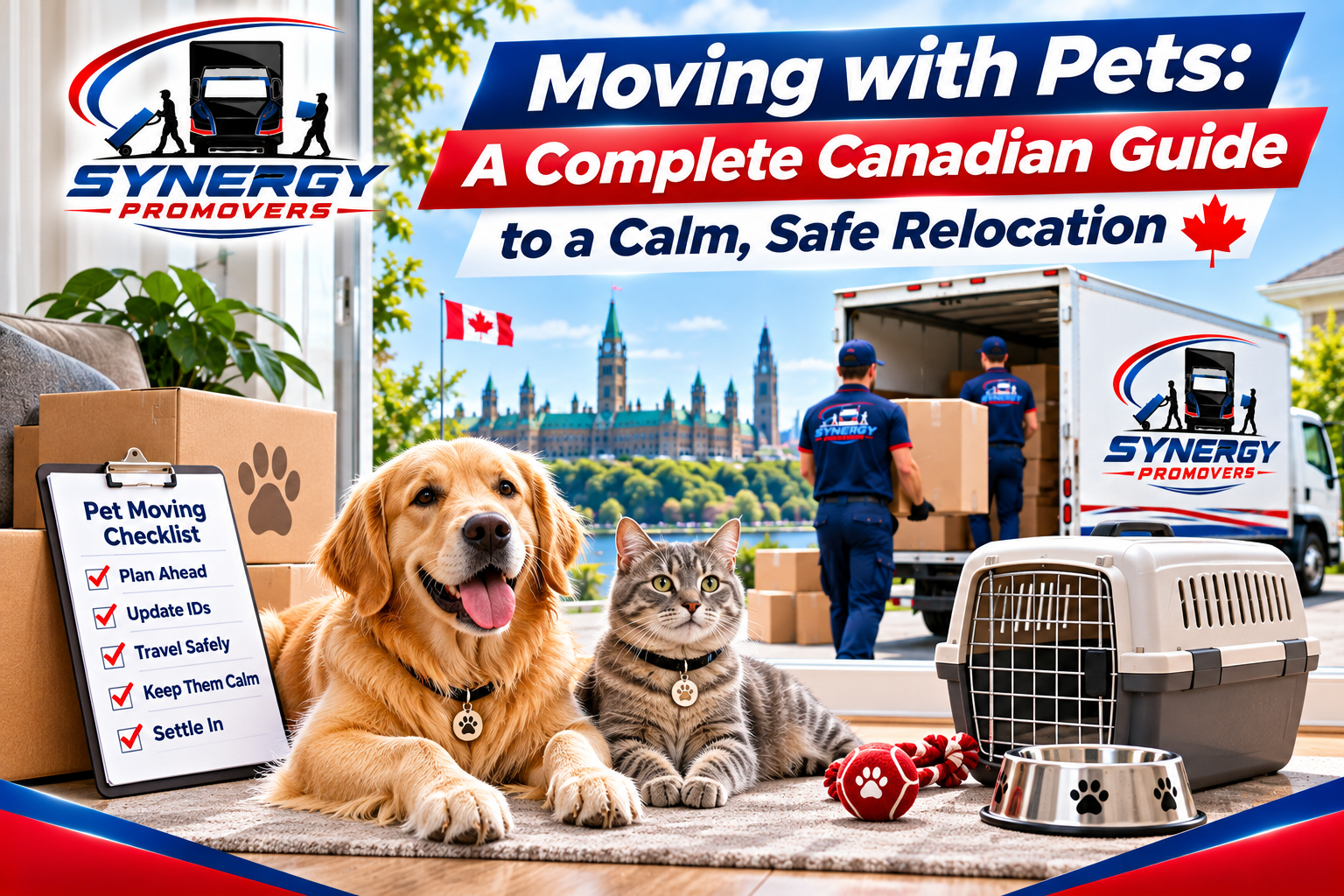
Moving is one of the most stressful events a household can go through — and your pets feel every bit of it. New smells, disrupted routines, unfamiliar vehicles, and the sudden absence of their favourite sunny spot can turn even the calmest dog or cat into an anxious shadow of themselves. The good news: with the right preparation, you can protect your pet’s health, keep their stress manageable, and arrive at your new home with a companion who is tired but safe rather than traumatised.
This guide covers everything Canadian households need to know about moving with pets — across town, across provinces, or across borders — including anxiety management, travel logistics, regulations, and what pet-friendly moving companies actually do (and don’t do).
Key Takeaways
- Pets experience moves as loss of territory, not adventure. Expect behaviour changes for 2–6 weeks and plan accordingly.
- Vet paperwork is the single most time-sensitive task. Interprovincial travel is usually straightforward, but international moves can require months of lead time for vaccinations, titre tests, and health certificates.
- Movers legally cannot transport live animals in the moving truck. Pets travel with you, with a specialty pet relocation service, or by air cargo.
- Anxiety is managed through routine, familiar scent items, and gradual carrier/crate training — not primarily through medication.
- The first 48 hours in your new home matter most. Set up a small, quiet “base camp” room before anything else is unpacked.
Why Moving Is So Hard on Pets (and What That Means for You)
Dogs and cats are territorial animals. Their sense of safety is built on familiar scents, predictable routines, and knowing where food, water, and their humans are at all times. A move strips away all three at once. Cats tend to internalise the stress — hiding, refusing food, over-grooming — while dogs usually externalise it through clinginess, pacing, accidents in the house, or sudden reactivity.
Understanding this changes how you plan. Moving with pets is less about the single travel day and more about the three weeks before and the three weeks after. The travel itself is often the easiest part.
Signs of moving-related stress to watch for
- Hiding for longer than usual, especially in cats
- Refusing food or water for more than 24 hours
- Excessive panting, drooling, or trembling in dogs
- Destructive behaviour that is out of character
- Digestive upset, accidents, or over-grooming
- Vocalisation changes (whining, howling, excessive meowing)
If any of these persist beyond a few days — or appear severe from the start — call your veterinarian. Some pets genuinely benefit from short-term anxiety support, and that conversation is best had before moving day, not during it.
Planning Timeline: What to Do and When
A realistic timeline prevents the two biggest failures of moving with pets: rushed vet visits and last-minute paperwork panic.
| Timeframe | Priority Tasks |
| 8–12 weeks out | Book vet checkup · research destination regulations · start crate/carrier desensitisation · for international moves, begin vaccination and documentation sequence |
| 4–6 weeks out | Order ID tags with new address · update microchip registration details · request vet records in writing · book pet-friendly accommodation if driving long distance |
| 2 weeks out | Refill medications (minimum 2-week buffer) · pack a dedicated pet bag · confirm travel arrangements · if flying, confirm airline crate requirements |
| Moving week | Maintain normal feeding and walking times · keep one familiar item unwashed (bed, blanket, toy) · prepare a quiet room for moving day |
| Moving day | Secure pets in a closed room or with a trusted friend before movers arrive · travel with pets personally · bring the pet bag in the vehicle, not the truck |
| First 48 hours | Set up base-camp room first · maintain feeding schedule to the minute · keep cats indoors for at least 2 weeks · supervise all outdoor time for dogs |
How to Move with a Dog: Specific Tips
Dogs generally travel better than cats, but they also pick up on human stress more intensely. Keep your own voice calm and your routine boringly predictable in the days before the move.
Before the move: Walk your dog on the same schedule you’ve always used. Introduce the travel crate or seatbelt harness weeks in advance with treats and short practice drives. If your dog has never done a long car trip, build up from 15 minutes to a few hours.
On moving day: Feed a light meal 3–4 hours before travel to reduce the risk of motion sickness. Stop every 2–3 hours on long drives for water, bathroom breaks, and a short walk. Never leave a dog alone in a parked vehicle — even in mild weather, interior temperatures rise dangerously fast.
At the new home: Walk the perimeter of the property on-leash first, let your dog investigate one room at a time, and keep feeding bowls and bed in consistent locations. Resume walks on familiar routes as soon as possible — new neighbourhoods are exciting, but also where recall failures happen.
Moving with Cats: A Different Playbook
Cats need the opposite of what dogs need: less stimulation, not more exploration. Moving with cats successfully is mostly about reducing sensory overload.
Use a hard-sided carrier with a secure latch, lined with a blanket that already smells like home. A covered carrier (a towel draped over it) reduces visual stimulation and lowers stress dramatically. In the car, secure the carrier on the floor behind the passenger seat or buckled in — not loose on a seat.
At the new home, open the carrier inside one small, quiet room — a bedroom or bathroom works well — containing the litter box, food, water, and a hiding spot. Let your cat emerge on their own schedule, which may be minutes or days. Keep them confined to this base-camp room for 3–7 days before allowing access to the rest of the home. Indoor-outdoor cats should stay strictly indoors for at least two weeks; the bond to the new territory needs time to form, or they will try to return to the old one.
Managing Moving-with-Pets Anxiety
Anxiety during a move is normal. Severe anxiety is manageable, but rarely with a single tool.
Environmental approaches work first and work well for most pets: familiar bedding and toys that haven’t been washed, feeding on the exact same schedule, keeping one room calm and low-traffic, and minimising your own visible stress around them.
Pheromone diffusers and sprays (synthetic versions of calming pheromones for dogs and cats) are widely available and low-risk. Many owners find them helpful in the final week at the old home and the first weeks in the new one.
Veterinary support is appropriate when environmental measures aren’t enough. Ask your vet about options well before moving day — some medications require a trial dose to find the right fit, and this is not something to figure out in a hotel parking lot. Never give human anti-anxiety or sleep medications to pets; many are toxic.
Moving with Pets Long Distance Across Canada
A cross-country move within Canada is logistically simpler than most people fear. There are generally no interprovincial restrictions on moving pet dogs and cats domestically, though it’s always worth confirming with your destination province if you’re moving livestock, exotic pets, or more than a few animals.
Driving: For moves spanning multiple days, book pet-friendly accommodation in advance. Major hotel chains are increasingly pet-friendly but policies vary — confirm pet fees, size limits, and whether pets can be left in rooms. Plan driving days of no more than 8–10 hours when possible, with meaningful breaks.
Flying domestically: Small pets may travel in-cabin on most Canadian airlines if they fit in an approved under-seat carrier. Larger pets travel as checked baggage or cargo. Each airline has its own crate specifications, breed restrictions (snub-nosed breeds like pugs and Persians are often restricted due to breathing risks), and temperature embargoes during summer and winter extremes. Book pet travel directly by phone, not online, to confirm availability.
Specialty pet relocation services handle door-to-door transport, paperwork, and airline coordination. They are the right choice when you’re moving internationally, flying a snub-nosed breed, relocating multiple animals, or simply unable to travel with your pet yourself.
Moving with Pets Cross Country into or out of Canada
International pet relocation requires the most lead time and the most careful paperwork. Requirements depend entirely on the destination country and change periodically, so always confirm current rules with the official veterinary authority of both the origin and destination country well before booking anything.
Generally, moving pets internationally involves some combination of:
- Microchip identification meeting international (ISO 11784/11785) standards, implanted before rabies vaccination
- Current rabies vaccination, often with specific timing requirements (e.g., at least 21–30 days before travel, and not expired)
- Rabies titre blood test for some destinations, with waiting periods that can extend to several months
- Official health certificate issued by a licensed veterinarian and, in Canada, endorsed by the Canadian Food Inspection Agency (CFIA) within a specific window before travel
- Additional parasite treatments (tapeworm, ticks) for certain countries
- Import permits for some destinations
For pet travel in or out of Canada, the CFIA publishes current import and export requirements by species and destination. Review these directly at the source rather than relying on third-party summaries, which can lag behind rule changes.
Canadian Food Inspection Agency — Travelling with pets
International pet relocation specialists are strongly recommended for complex routes, long-haul flights, or any destination with rabies-free or strict import rules (such as the UK, Australia, Japan, Hawaii, or New Zealand).
Pet Travel Canada Regulations: The Essentials
For travel within Canada, there are no federal entry requirements for pet dogs and cats moving between provinces, though airlines and ferry operators have their own rules.
For pets entering Canada from abroad, the CFIA sets import requirements that differ based on the country of origin and the animal’s age. Dogs and cats from most countries need proof of current rabies vaccination; dogs from certain high-risk countries face additional restrictions and may require import permits.
For pets leaving Canada, the rules are set by the destination country, not by Canada. Your veterinarian can help prepare documentation, but the responsibility to confirm the destination country’s requirements is yours. Always use the destination’s official government source.
Pet-Friendly Moving Companies: What They Do and Don’t Do
A common misconception is that a “pet-friendly moving company” transports your pets. They do not. Across Canada, licensed moving companies are not permitted to carry live animals in the moving truck — it’s a liability, welfare, and insurance issue, not a service limitation.
What a pet-friendly moving company does is work around your pets:
- Schedule the move to minimise disruption (for example, loading on a day you can keep pets off-site)
- Recommend trusted pet relocation partners if you need professional pet transport
- Advise on packing timing so your pet’s familiar items travel with you, not in the truck
- Secure doors and gates carefully during loading — a surprising number of escapes happen because a door was propped open
- Offer flexibility on arrival timing so you can settle pets into the new home first
If a mover doesn’t ask whether you have pets during the quote, that’s a signal they’re not thinking about your household as a whole.
The First 48 Hours in the New Home
This window matters more than the travel day. Set up a single “base camp” room before any serious unpacking: your pet’s bed, bowls, litter box (for cats), familiar toys, and a water source. Close the door and let the rest of the move happen around it.
Feed at the exact times you fed at the old home. Walk dogs on the same schedule. Resist the urge to introduce every new room on day one — pets settle faster when the world shrinks temporarily, then expands slowly. Most dogs relax within a few days; cats typically need 1–2 weeks to feel secure in the new territory, and up to a month to fully adjust.
Update microchip registration and ID tags with the new address immediately. A pet who slips out in the first week is in unfamiliar territory with no scent trail home.
Working with Movers You Can Trust
A smooth moving day is the foundation of a calm first week for your pet. The less chaotic the loading process, the less your pet’s stress spills into the new home. When choosing a moving company, look for clear communication, a written estimate with no surprise fees, transparent insurance coverage, and real reviews that mention how the crew handled homes with pets or children.
Synergy Pro Movers offers residential and long-distance moving services in Canada, with the flexibility to coordinate move-day timing around households with pets. We don’t transport animals — no licensed mover does — but we do plan loading and delivery windows that give you the space to settle your pet first. If you’re planning a local or cross-province move and want to discuss timing around your family’s needs, we’re happy to walk through options with you.
Synergy Pro Movers is a Canadian moving company. This guide is general information and is not a substitute for veterinary advice or official government regulations, which should always be confirmed directly with your veterinarian and the relevant authority.
Frequently Asked Questions
How far in advance should I start preparing my pet for a move?
Start at least 4–6 weeks before moving day for a domestic move, and 3–6 months before for an international move. Early preparation covers vet checkups, carrier desensitisation, documentation, and gradual routine adjustments. The earlier you start, the less your pet experiences the move as a sudden shock.
Can my movers take my pet in the moving truck?
No. Licensed moving companies in Canada do not transport live animals — it’s a welfare, liability, and insurance issue across the industry. Pets travel with you in your vehicle, with a specialised pet relocation service, or by air. A good moving company will plan around your pet’s needs, not take them along.
What’s the best way to move with a cat long distance?
Use a hard-sided covered carrier secured in your own vehicle, bring a familiar unwashed blanket, and plan the shortest reasonable route with minimal overnight stops. On arrival, confine your cat to a single quiet base-camp room for 3–7 days before letting them explore. For flights, book directly with the airline and confirm in-cabin eligibility based on carrier size.
Do I need special documents to move with my pet between Canadian provinces?
Generally no — there are no federal interprovincial restrictions on moving pet dogs and cats within Canada. However, airlines and ferry operators have their own rules, and it’s always wise to travel with a current rabies vaccination certificate and your vet’s contact information in case of an emergency en route.
How do I help a pet with severe moving anxiety?
Start with environmental consistency: familiar bedding, unchanged feeding times, pheromone diffusers, and a quiet base-camp room. For pets whose anxiety is severe or who have a history of panic during travel, speak with your veterinarian well before moving day. They may recommend short-term anxiety medication, but this requires a trial run — never experiment on the move itself. Never use human medications on pets.
What should I know about moving pets internationally from Canada?
International moves require microchipping, up-to-date rabies vaccination, an official health certificate endorsed by the Canadian Food Inspection Agency, and sometimes rabies titre tests, parasite treatments, or import permits — depending on the destination. Requirements vary significantly by country, so always confirm current rules with the destination country’s official veterinary authority and the CFIA. For rabies-free destinations like Australia or the UK, start the process at least 6 months ahead.
Are there pet-friendly moving companies that specialise in animal transport?
“Pet-friendly moving companies” are moving companies that work carefully around households with pets — they don’t transport the animals themselves. For actual pet transport, especially long-distance or international, use a dedicated pet relocation service. These companies handle crates, airline bookings, paperwork, and door-to-door logistics. They are strongly recommended for international moves, snub-nosed breeds, or households moving multiple animals.