
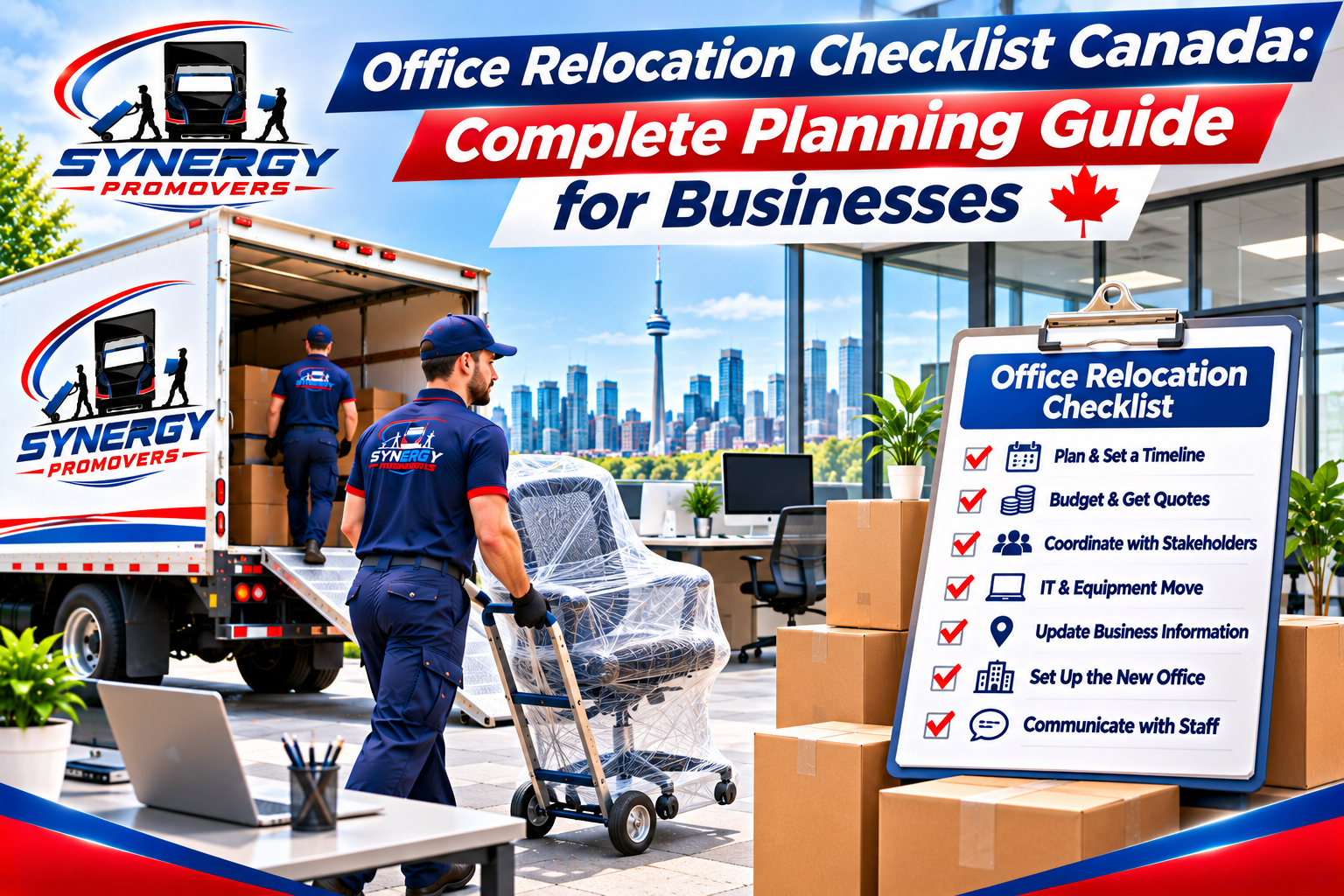
Moving an office is one of the most complex logistical challenges a company faces. Between coordinating IT infrastructure, managing employee transitions, securing the right insurance documentation, and meeting commercial building requirements, even a small oversight can result in costly downtime. This guide walks you through every phase of a commercial move in Canada — from the earliest planning stages to your first week in the new space — so you can execute the transition with minimal disruption to your operations.
Key Takeaways
– Begin planning at least 12 weeks in advance for small-to-medium offices and 16–24 weeks for larger or multi-floor relocations.
– IT and server migration requires a dedicated workstream with a detailed cutover schedule to prevent data loss and connectivity gaps.
– Most Class-A commercial towers in Toronto and Ottawa require movers to present a $5 million Commercial General Liability COI and a current WSIB Clearance Certificate.
– You must update your business address with the Canada Revenue Agency, provincial registries, and key vendors within specific timeframes to remain compliant.
– Scheduling your physical move after hours or over a weekend is the single most effective way to eliminate operational downtime.
How Far in Advance Should a Company Start Planning an Office Move in Canada?
Most Canadian businesses should begin planning their office relocation at least 12 weeks before the target move date. Smaller offices with fewer than 30 workstations can sometimes compress this to 8 weeks, while large corporate relocations involving multiple floors, specialized equipment, or inter-city transfers — such as a move between Ottawa and Toronto — typically require 16 to 24 weeks of lead time.
The planning window depends on team size, IT infrastructure complexity, whether the new space requires buildout, and the availability of commercial movers in your market. During high-demand periods from late spring through early fall, securing a qualified crew in markets like the Toronto Financial District or Downtown Ottawa commercial towers can take longer, so booking early is essential.
The Complete Commercial Moving Checklist by Phase
A structured office moving checklist template keeps every stakeholder aligned and prevents critical tasks from slipping through the cracks. Use this office relocation checklist Canada framework to break your corporate relocation planning guide into five clear phases.
12–8 Weeks Before: Strategic Planning
– Confirm your new lease terms. Review the commercial lease for move-in dates, loading dock access windows, freight elevator reservation policies, and any commercial lease decommissioning and broom-swept condition clauses for your current space.
– Appoint an internal move manager. Designate a single point of contact to coordinate between departments, vendors, and building management.
– Audit your current inventory. Document every workstation, piece of modular furniture, server rack, and specialty item. Decide what moves, what gets replaced, and what gets decommissioned.
– Request quotes from commercial movers. Obtain at least three detailed proposals. Confirm each mover carries the insurance and WSIB documentation your new building requires.
– Develop a preliminary office move project plan. Map out milestones, department responsibilities, and a communication schedule for employees.
– Begin the color-coded floor plan labeling system for office moves. Assign a color to each department or zone in the new office. Label every piece of furniture and every box with the corresponding color to streamline placement on move day.
8–4 Weeks Before: Logistics and Vendor Coordination
– Finalize the new office layout. Confirm desk assignments, meeting room configurations, and common area setups with your move manager and department heads.
– Coordinate IT and telecom vendors. Schedule the VoIP phone and fiber optic cutover for the new location. Confirm that your internet service provider can deliver the required bandwidth by move-in day.
– Order packing supplies. Evaluate plastic moving crates vs cardboard boxes for office relocation. Reusable nestable plastic E-crates offer better protection for electronics and reduce waste, while cardboard may be more practical for lightweight archive storage.
– Notify employees. Share the timeline, new address, parking details, and any changes to commute patterns. Provide clear instructions on what employees should pack personally versus what the movers will handle.
– Book the commercial freight elevator. Most Downtown Toronto Class-A office buildings and Ottawa business districts require elevator reservations at least two to four weeks in advance.
– Arrange after-hours or weekend access. If you plan to move outside business hours to minimize disruption, confirm that both the old and new buildings permit weekend or overnight access.
4–2 Weeks Before: IT, Compliance, and Final Prep
– Execute the IT and server relocation checklist for your office move. Back up all data, label every cable and connection, and prepare anti-static bubble wrap for sensitive components. Your IT team or a specialized vendor should manage server rack migration separately from the general freight.
– Collect compliance documents. Ensure your moving company provides a current WSIB Clearance Certificate and a 5MCommercialGeneralLiabilityCertificateofInsurance(COI).Forwardthesetothepropertymanagementofficesatbothlocations.-**Beginaddresschangenotifications.**Startupdatingyourbusinessaddresswithgovernmentagencies,financialinstitutions,andkeyvendors(seethedetailedsectionbelow).-**Planforconfidentialdocumenthandling.**Ifyourofficehandlessensitiveclientfiles,medicalrecords,orlegaldocuments,arrangeachainofcustodyprotocolwithyourmovers.Rollingsecuritycagesandsealedcontainershelpmaintaindocumentintegrityduringtransit.-**Confirmmodularcubicleandergonomicdeskdisassemblyandreassembly.**Verifywhetheryourmovingcrewhandlesfurnituredisassemblyorwhetheryouneedaspecializedofficefurnitureinstaller.###MovingWeekandDay-OfExecution-Conductafinalwalkthroughofboththeoldandnewspaceswithyourmovemanagerandthemovingcrewlead.-Verifythefloorplanlabelingsystemisvisibleoneveryitemandthatthenewofficefloorismarkedwithcorrespondingzonelabels.-**StageITequipmentseparately.**Servers,networkswitches,andVoIPhardwareshouldtravelinclimate-controlled,anti-staticpackaging—notonthegeneralfreighttruck.-**Assignapointpersonateachlocation.**Oneteammemberoverseesloadingattheoldoffice;anotherdirectsplacementatthenewone.-**Documenttheconditionofbothspaces.**Photographwalls,floors,andfixturesbeforeandafterthemovetoprotectyoursecuritydepositandsupportanyleaserestorationclaims.###Post-Move:FirstWeekintheNewOffice-**TestallITsystems.**Verifynetworkconnectivity,VoIPlines,printerqueues,andserveraccessbeforeemployeesarriveonMondaymorning.-**Inspectfurnitureandequipment.**Checkfortransitdamageandfileclaimswiththemovingcompanywithintherequiredwindow,typically48to72hours.-**Completeyourcommercialleasedecommissioning.**Ensuretheoldofficemeetsthebroom-sweptconditionspecifiedinyourlease.Scheduleanyrequiredrepairsorleaserestorationwork.-**UpdateyourGoogleBusinessProfile.**Verifythenewaddresssoclientsandpartnerscanfindyou.GBPverificationatthenewlocationcantakeseveraldays,soinitiatethisasearlyaspossible.-**Gatheremployeefeedback.**Identifyanyworkspaceissues—lighting,HVAC,connectivity—andaddressthemquicklytomaintainmorale.##ITandServerRelocation:ProtectingYourTechnologyInfrastructureTheITandserverrelocationchecklistforanofficemovedeservesitsowndedicatedworkstreambecausetechnologyfailuresaretheleadingcauseofpost-movedowntime.Atypicalserverrackmigrationinvolvesthefollowingsteps:1.Fulldatabackuptobothon-siteandcloudstorageatleast48hoursbeforethemove.2.Cablemappingandlabelingofeveryconnectionontheserverrack,networkswitches,andVoIPsystems.3.Controlledshutdownfollowingmanufacturerprotocolstopreventdatacorruption.4.Anti-staticpackagingusinganti-staticbubblewrapandfoaminsertsforallsensitivehardware.5.Climate-controlledtransportinadedicatedvehicle,separatefromgeneralofficefreight.6.Stagedreinstallationatthenewsite,beginningwithcorenetworkinfrastructureandrollingouttoindividualworkstations.7.VoIPphoneandfiberopticcutoverschedulingcoordinatedwithyourtelecomprovidertoensurethenewcircuitsarelivebeforethephysicalmove.Whoisresponsiblefordisconnectingandreconnectingcomputersandserversduringanofficemove?Inmostcases,yourinternalITteamoracontractedmanagedserviceproviderhandlesthetechnicaldisconnectionandreconnection,whilethecommercialmovingcrewmanagesthephysicaltransport.Clarifythisdivisionoflaborinyourmovingcontracttoavoidgapsinaccountability.##Insurance,WSIB,andComplianceDocumentsYourMoversNeedCommercialbuildingmanagementcompanies—particularlythoseoperatingClass-AofficetowersintheTorontoFinancialDistrict,DowntownOttawa,andMontreal’sdowntowncommercialcore—enforcestrictinsuranceandsafetyrequirementsforanymovingcompanyaccessingtheirproperties.Thetwodocumentsyouwillalmostalwaysneed:-5 Million Commercial General Liability Certificate of Insurance (COI). This protects the building against property damage caused by the moving crew. The property manager will typically require the COI to name the building owner as an additional insured party.
– Workplace Safety and Insurance Board (WSIB) Clearance Certificate. In Ontario, the WSIB Clearance Certificate confirms that the moving company is in good standing with the province’s workplace safety insurance program. Without it, building management may deny elevator access. You can verify a mover’s WSIB status directly through the WSIB online portal.
Beyond these two, some buildings may also require proof of commercial auto insurance, a site-specific safety plan, or a moving bond. Request the complete list of requirements from both your current and new property managers at least six weeks before the move. These commercial building COI and WSIB requirements for office movers vary by property, so never assume one building’s rules apply to another.
Who to Notify When Changing Your Business Address in Canada
Failing to update your business address promptly can result in missed tax correspondence, disrupted vendor deliveries, and compliance issues. Here is a prioritized notification list for anyone wondering who to notify when changing business address in Canada:
Government and Regulatory Bodies
– Canada Revenue Agency (CRA). Update your Business Number (BN) address through your CRA My Business Account or by submitting Form RC1. The CRA recommends making this change within 30 days of your move. Visit canada.ca for the current process.
– Provincial business registries. In Ontario, update your address through the Ontario Business Registry. Quebec businesses should update their registration with the Registraire des entreprises.
– Municipal business licence office. If your city requires a business licence, notify the local licensing authority.
Financial and Legal
– Your business bank and credit card providers
– Your commercial insurance broker
– Your corporate lawyer and accountant
– Payroll service provider
Operational
– Key vendors and suppliers
– Clients and partners (send a formal address change notice)
– Canada Post (set up mail forwarding for at least six months)
– Industry associations and professional regulatory bodies
Minimizing Downtime: After-Hours and Weekend Moves
For most businesses, the question of how to move an office with zero business downtime comes down to scheduling. The most reliable approach is to hire after-hours and weekend commercial office movers who can complete the physical relocation outside your normal operating hours.
A typical weekend move schedule looks like this:
– Friday evening (after 6 PM): Movers begin disassembly and packing at the old location.
– Saturday (full day): Transport and placement at the new office. IT team reconnects servers and network infrastructure.
– Sunday: IT testing, furniture adjustments, and final walkthrough.
– Monday morning: Employees arrive at a fully operational workspace.
This approach does carry a premium — after-hours and weekend rates are higher than standard weekday moves — but the cost is almost always lower than the revenue lost from one or more days of operational downtime. When evaluating quotes, compare the total cost of a weekend move against the daily revenue impact of shutting down your operations.
Cost Drivers for Commercial Office Relocations
The cost of commercial office relocation per workstation varies widely depending on several factors. Rather than relying on a single per-desk figure, evaluate your budget against these primary cost drivers:
– Distance and accessibility. A move within the same Ottawa business district or between Mississauga, Vaughan, and Markham costs less than an inter-city relocation from Kingston or Belleville to Toronto. High-rise buildings with limited freight elevator access add time and labor.
– Volume and complexity. The number of workstations, the presence of modular cubicles requiring disassembly, and specialty items like server racks or laboratory equipment all increase costs.
– Timing. After-hours, weekend, and holiday moves command premium rates. Peak season from May through September may also carry surcharges.
– Packing and materials. Full-service packing, plastic moving crates, and specialized IT packaging add to the total.
– Insurance and compliance. Buildings with stringent COI and WSIB requirements may limit your mover options, potentially affecting pricing.
– Lease restoration. The cost of returning your old space to broom-swept condition — including wall repairs, carpet cleaning, and fixture removal — is often overlooked in initial budgets.
Request itemized quotes from at least three commercial moving companies and compare scope, not just bottom-line price.
Office Move Project Plan: Assigning Roles and Responsibilities
A successful commercial office relocation timeline depends on clear ownership of every task. Assign the following roles early in the planning process:
| Role | Responsibility | Key Deliverable |
|——|—————|—————–|
| Executive Sponsor | Budget approval, strategic decisions | Signed moving contract |
| Internal Move Manager | Day-to-day coordination, vendor management | Master project timeline |
| IT Lead | Server migration, network cutover, VoIP transition | IT cutover schedule |
| Facilities / Office Manager | Floor plan, furniture, building coordination | Color-coded floor plan |
| HR / Communications | Employee notifications, new-office orientation | Staff communication plan |
| Finance | Budget tracking, vendor payments, address updates | Updated vendor records |
| Department Heads | Team-level packing instructions, inventory sign-off | Department inventory lists |
Hold weekly check-in meetings starting at the 8-week mark and increase to daily stand-ups during moving week.
Planning Your Next Office Move with Professional Support
An office relocation involves dozens of interdependent tasks, and the cost of a misstep — lost data, damaged equipment, extended downtime — far exceeds the investment in professional planning and execution. Whether you are moving within Kanata North Tech Park, relocating to a Class-A tower in the Toronto Financial District, or coordinating a government office transition in Gatineau, working with an experienced commercial moving team reduces risk at every stage.
Synergy Pro Movers provides commercial office moving services tailored to Canadian businesses of all sizes. Our crews handle IT-sensitive relocations, after-hours scheduling, and the compliance documentation that Class-A buildings demand. If your move spans multiple cities, our teams of office movers in Toronto, commercial movers in Ottawa, and our Montreal commercial moving crew coordinate seamlessly to keep your project on schedule.
Synergy Pro Movers is a commercial moving company. This office relocation checklist Canada guide provides general planning information; confirm all regulatory and building-specific requirements with your property manager and legal advisor.
Frequently Asked Questions
How far in advance should a company start planning an office move in Canada?
Most businesses need 12 to 16 weeks of lead time for a standard office relocation. Large corporate moves involving multiple floors, specialized IT infrastructure, or inter-city transfers may require 24 weeks or more. Start by confirming your new lease dates and booking your moving crew early, especially during peak summer months.
How much does it cost to relocate a small or medium-sized office in Ontario?
Costs depend on workstation count, distance, building access, timing, and the complexity of your IT setup. Rather than relying on generic per-desk estimates, request itemized quotes from at least three commercial movers that account for disassembly, IT handling, after-hours premiums, and lease restoration at your old location.
What insurance and WSIB documents do Class-A commercial office towers require from movers?
Most Class-A towers require a $5 million Commercial General Liability COI naming the building owner as additionally insured, plus a current WSIB Clearance Certificate confirming the mover is in good standing with Ontario’s workplace safety insurance program. Some buildings also require commercial auto insurance proof and a site-specific safety plan.
Who is responsible for disconnecting and reconnecting computers and servers during an office move?
Typically, your internal IT team or a managed service provider handles the technical disconnection, data backup, and reconnection. The commercial moving crew manages the physical transport of hardware in anti-static, climate-controlled packaging. Define this split clearly in your moving contract to prevent accountability gaps.
Can commercial movers move our office overnight or over the weekend?
Yes. Most commercial moving companies offer after-hours and weekend scheduling specifically to eliminate business downtime. Weekend moves typically follow a Friday-evening-to-Sunday schedule so employees return to a fully operational office on Monday. Expect a rate premium for off-hours work.
Where do I need to update my business address with the CRA and government when moving offices?
Update your Business Number address through your CRA My Business Account or Form RC1, ideally within 30 days of the move. You should also update your provincial business registry (Ontario Business Registry or Quebec’s Registraire des entreprises), your municipal business licence office, and Canada Post for mail forwarding.
What is the difference between plastic moving crates and cardboard boxes for an office relocation?
Plastic moving crates (often called E-crates) are reusable, stackable, and provide superior protection for electronics and fragile items. They also reduce waste compared to single-use cardboard. Cardboard boxes remain practical for lightweight archive storage and personal desk items. Many commercial movers offer both options as part of their packing service.
How do I handle confidential documents during an office move?
Establish a chain of custody protocol before the move. Use sealed, numbered containers or rolling security cages for sensitive files, and assign a dedicated team member to oversee their transport. If your office handles regulated information such as legal, medical, or financial records, confirm that your moving company’s confidentiality procedures meet your industry’s compliance standards.